
Here’s my unfashionable read: “triple-agonist” is the least interesting thing about retatrutide, and treating it as the headline gets the story backwards. Everyone wants to talk about how three is more than two, as if receptor count were a scoreboard. I’d argue the number of locks matters far less than which lock got added last, because the third one retatrutide turns on is a hormone that, on paper, should work against the drug’s own goal. That tension, not the tally, is the actual mechanism worth understanding.
No shopping list here, no rankings dressed up as advice. Just an argument, backed by the trial data, about what this molecule is actually betting on. Every number below traces back to the primary papers in the references, so check my math against the source if you want.
The baseline everyone already knows
An agonist is just a molecule that flips a switch, a receptor, on a cell. Semaglutide, the compound behind Ozempic and Wegovy, flips one switch: GLP-1. That single switch does real work. It slows stomach emptying, quiets appetite signals in the brain, and helps the body release insulin appropriately after a meal. One switch, well-tuned, built an entire drug category. Keep that as your reference point, because everything that follows is variations on it.
The step everyone treats as obvious: adding GIP
Tirzepatide, the molecule in Mounjaro and Zepbound, flips two switches: GLP-1 plus GIP, a second gut hormone receptor tied to nutrient and insulin handling. Researchers still argue over exactly how GIP activation helps. What isn’t up for argument is the outcome: two switches beat one in head-to-head weight loss, and tirzepatide became the class’s new ceiling.
So the conventional read of retatrutide writes itself: one receptor worked, two worked better, why not try three? I think that framing is lazy, because it assumes the third addition is more of the same kind of lever. It isn’t.
The switch that should, in theory, fight the drug
The third receptor retatrutide activates is glucagon. If you remember anything about glucagon from a textbook, it’s that it raises blood sugar, it’s the hormone that tells your liver to dump stored glucose when levels drop. That is insulin’s opposite number. Bolting a glucagon agonist onto a drug meant to treat obesity and type 2 diabetes sounds, at first read, like an engineering mistake.
It isn’t, but the reason takes some unpacking, and it’s the part most explainers skate past. Glucagon also drives energy expenditure. The working theory is that GLP-1 and GIP handle the demand side, intake goes down, while glucagon handles the supply side, energy burn goes up, including in the liver. Less in, more out, from a single molecule.
That only works if the package is balanced. The GLP-1 arm of the same drug improves blood-sugar control, and the design leans on that to keep glucagon’s glucose-raising instinct from actually raising glucose in practice. This isn’t three separate drugs stapled together. It’s one molecule where the parts are tuned against each other on purpose. That’s the bet. Whether the bet paid off is a data question, not a design question, so let’s look at the data.
What the bet actually returned
In 2023, the New England Journal of Medicine published the Phase 2 obesity trial, led by Ania Jastreboff. At the top 12 mg dose, participants averaged 24.2% body-weight loss at 48 weeks, against 2.1% on placebo [1]. The lower doses weren’t far behind: about 22.8% at 8 mg, 17.1% at 4 mg.
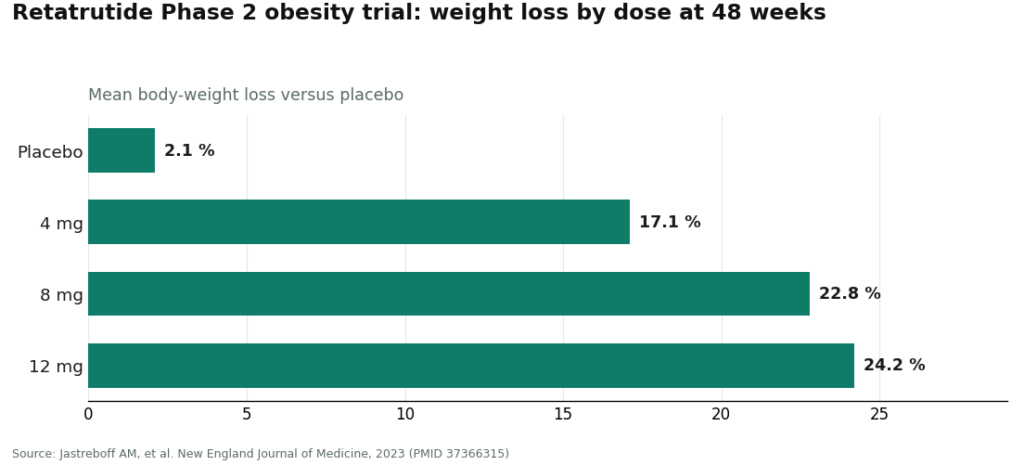
Do the arithmetic on that top figure. Someone starting at 230 pounds loses roughly 55 pounds over the trial period, on average. Nearly everyone on the top dose cleared 5% loss, and most cleared 10% and 15%. It’s the largest number this drug class has produced in a published trial, and the glucagon lever is the proposed reason it landed above the two-receptor drugs that preceded it.
The pattern held outside the obesity trial too, which is the kind of cross-check I actually trust. A separate 2023 Phase 2 trial in The Lancet, led by Julio Rosenstock, tested retatrutide in people with type 2 diabetes, where blood-sugar control was the primary goal, not weight. The top escalation group saw HbA1c drop by about 2.0 percentage points, alongside roughly 17% body-weight loss at the later timepoint [2]. Different population, different endpoint, same direction. If glucose control moved in the wrong direction here, the whole balancing-act theory would be in trouble. It didn’t. That’s a real point in the mechanism’s favor, and I’ll give it that credit plainly.
Where I get less confident, and where you should too
Here’s my honest limit, because a contrarian who won’t concede anything isn’t an analyst, just a cheerleader in a different jersey.
A receptor-level story explains why a drug might work. It says nothing about whether it works safely at scale, or for years, or in the messier population outside a trial’s inclusion criteria. Both results above are Phase 2, the middle stage of testing, run in a few hundred people over well under a year. Phase 2 exists to justify Phase 3, not to substitute for it. Retatrutide’s confirmatory program runs under the TRIUMPH name, with the flagship obesity study, TRIUMPH-1, registered as a master protocol under NCT05929066 [3]. Until that reads out and the FDA reviews it, “mechanistically compelling” is the accurate description. “Proven” is not, and anyone selling you the second word right now is ahead of the evidence.
The glucagon addition also brings its own line items to watch, beyond the nausea, diarrhea, vomiting and constipation that show up dose-dependently across the whole GLP-1 class. The trials recorded a dose-dependent rise in heart rate, a cardiovascular signal the larger studies are now specifically built to track. A molecule working both sides of the energy equation isn’t a free lunch. That heart-rate data point is, to me, the clearest piece of evidence that the “balance” in this molecule is a real engineering tightrope, not a marketing flourish. It’s also worth stating plainly, because the mechanism story is exciting enough that people skip past it: retatrutide is investigational. No FDA approval for any use, no brand name at a pharmacy, and the FDA has already sent warning letters to companies marketing it outside clinical trials. Vials sold online as “research chemicals” sit entirely outside the regulated system, and nobody buying one can verify what’s actually inside.
See also: How the Right Accounting Firm in Toronto Can Transform Your Business Finances
The reframe I’d actually defend
So here’s where I land, against the grain of most of the coverage I’ve read: the receptor count isn’t the achievement. The achievement, if the Phase 3 data confirms it, is that the designers found a way to make an intuitively counterproductive hormone pull weight in the right direction by offsetting it against a glucose-lowering partner in the same molecule. That’s a harder trick than “add a third appetite suppressant,” and it’s also a riskier one, which is exactly why the heart-rate signal shows up in the data rather than being a footnote. Calling it “triple-agonist” and moving on undersells both the cleverness and the risk. Neither the mechanism diagram nor a Phase 2 trial answers whether that tightrope holds for years, in ordinary patients, at scale. That’s what Phase 3 is for.
Given a drug that works both sides of the energy equation and carries a measurable heart-rate effect, the case for having a clinician in the loop isn’t a legal formality, it’s the actual point. A supervised telehealth provider such as FormBlends represents that model: a licensed clinician reviews history, screens for the conditions that make a heart-rate-raising drug a bad fit, and monitors the known gastrointestinal and cardiovascular effects over time. As an organization, FormBlends is upfront about retatrutide’s investigational status rather than presenting it as an available product, which is the opposite of how the gray market operates. A second name in this space, HealthRX.com (healthrx.com), works from the same clinician-in-the-loop premise and is similarly clear that an investigational triple-agonist isn’t something any pharmacy can hand over today. The structural point stands either way: a mechanism this active argues for more oversight, not less, and a vial in the mail from an unregulated seller strips every layer of it away.
The one-sentence version, my way
Retatrutide keeps the GLP-1 backbone, keeps the GIP receptor that made tirzepatide stronger, and then adds glucagon, a hormone that should raise blood sugar, betting that the same molecule’s glucose-lowering arm can hold it in check while it drives energy expenditure up. The Phase 2 numbers say the bet is working so far. The heart-rate signal says the bet has a cost. Phase 3 is where we find out if the trade is worth it.
The questions that keep coming up
What does the third receptor in retatrutide actually add that tirzepatide does not? The third target is glucagon, which tirzepatide doesn’t touch at all. Where GLP-1 and GIP mainly turn appetite and intake down, glucagon is thought to push energy expenditure up, including in the liver. That “more out” side, stacked on the existing “less in” effect, is the proposed reason the Phase 2 weight-loss numbers came in above the two-receptor drug.
Doesn’t adding a glucagon agonist just raise blood sugar? It would, if it were acting alone, but it isn’t. The same molecule’s GLP-1 arm improves blood-sugar control, and the three activities are tuned against each other so the glucose-lowering effect offsets glucagon’s tendency to push glucose up. In the type 2 diabetes trial, the net effect was an HbA1c drop of about 2.0 percentage points, not a rise [2].
Is “triple-agonist” the real reason retatrutide loses more weight, or is that just branding? It’s the proposed mechanism, and the data line up with it: one receptor produced a strong drug, two produced a stronger one, and the three-receptor version posted the highest published figure so far, about 24.2% at the top dose [1]. But “triple-agonist” is a description of the wiring, not a promise of the outcome. It explains the bet. Phase 3 is the actual test of it.
Does the more active mechanism bring new risks along with it? Yes, beyond the gastrointestinal effects common across the class. The trials logged a dose-dependent rise in heart rate, a cardiovascular signal the larger studies are specifically watching [1]. A drug pulling on both sides of the energy equation isn’t without cost, which is a core reason clinical supervision matters here.
Has the FDA signed off on retatrutide because the mechanism checks out? No. It’s investigational, unapproved for any use, and there’s no brand-name version any pharmacy can fill. The confirmatory Phase 3 program, TRIUMPH, with the flagship obesity study registered under NCT05929066, still has to read out and clear FDA review before this moves from promising to proven [3].
What is retatrutide and how is it different from other weight-loss drugs?
Retatrutide is an investigational injectable that activates three gut-hormone receptors at once: GLP-1, GIP, and glucagon. Most approved drugs hit one or two of those. Glucagon is the addition that matters, because it’s thought to push the liver toward burning more fat and raises resting energy expenditure, something the two-receptor drugs don’t do as directly. It remains in clinical trials and is not FDA-approved.
What does retatrutide actually do inside the body?
It slows stomach emptying and cuts appetite through GLP-1, improves insulin sensitivity through GIP, and raises metabolic rate through glucagon signaling. Combined, that produced substantial weight loss in Phase 2 trials, averaging around 17 percent of body weight at 24 weeks in some dose groups, though Phase 3 data are still being gathered and the final numbers could shift.
How do you get retatrutide legally right now?
Right now, the two legitimate paths are enrolling in an active clinical trial or working with a physician-supervised compounding pharmacy, such as FormBlends, operating under proper regulatory oversight. Buying peptides labeled “for research only” from online sellers puts you outside any medical supervision and carries real purity, dosing, and safety risk. No version is FDA-approved yet, so your prescribing clinician’s judgment matters a lot.
Is retatrutide safe to use?
The honest answer is the safety picture is still being written. Phase 2 data showed side effects typical of the GLP-1 class, mainly nausea, vomiting, and diarrhea, usually dose-dependent and heaviest early on. Glucagon agonism adds theoretical concerns around heart rate and blood pressure that longer trials are still tracking. Anyone calling it proven-safe today is getting ahead of what the evidence supports.
References
- Jastreboff AM, et al. Triple-hormone-receptor agonist retatrutide for obesity: a Phase 2 trial. New England Journal of Medicine, 2023. Reported ~24.2% mean body-weight loss at 48 weeks on the 12 mg dose vs 2.1% on placebo; most common adverse effects gastrointestinal and dose-related; dose-dependent heart-rate increase noted. PMID 37366315. https://pubmed.ncbi.nlm.nih.gov/37366315/
- Rosenstock J, et al. Retatrutide, a GIP, GLP-1 and glucagon receptor agonist, for people with type 2 diabetes: a randomised, double-blind, placebo- and active-controlled, parallel-group, Phase 2 trial. The Lancet, 2023. Reported ~2.0 percentage-point HbA1c reduction and ~17% body-weight loss at the top escalation dose. PMID 37385280. https://pubmed.ncbi.nlm.nih.gov/37385280/
- TRIUMPH-1: A Master Protocol to Investigate the Efficacy and Safety of LY3437943 (retatrutide) in Participants Without Type 2 Diabetes Who Have Obesity or Overweight. Phase 3, Eli Lilly and Company. ClinicalTrials.gov NCT05929066.