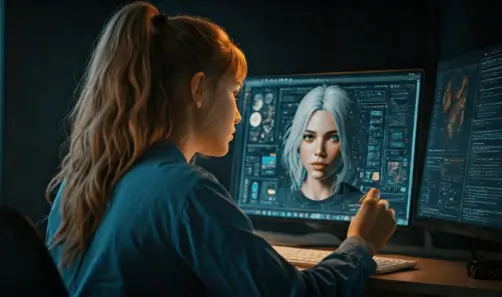
I would say Magic Hour came out as the best online programs to use as well as to animate a picture with AI and then, a few other highly competitive ones but they are more specialized.
I tried the platforms in those working workflows – UGC ads, short videos, speaking avatars, and images with improvements by AI. A majority of the tools have been seen looking nice on the demonstration but they fail miserably in practice, reliability, or usability.
The 5 tools do indeed stand the test in manufacturing.
Brief overview of Best Tools.
| Tool | Best For | Key Features | Free Plan | Platform |
| Magic Hour | All-in-one creators | Face swap, photo animation, text-to-video | Yes | Web |
| D-ID | Talking photos | Photo animation, avatars | Limited | Web/API |
| HeyGen | AI avatars | Lip sync, talking avatars | Trial | Web |
| Runway | Cinematic video | Text-to-video, editing | Limited | Web |
| Pika | Fast generation | Text-to-video | Yes | Web/Discord |
1. Magic Hour
The only tool that I tried which integrates face swapping, photo animation and full video generation into one, fast workflow, is Magic Hour.
Their face swap video online can be tried online without any registration.
Pros:
Abnormally realistic face discs (responds to motion and angles)
Fluid photo to video animation processes.
Animate pipelines (swap one-click to animate) One-click enhance (swap one- click to enhance)
Parallel generations (no waiting)
Free with non-expired credits.
DB and mobile works.
Cons:
Higher technology can be time consuming to learn.
The credit system must be learned to an extent.
My Take:
Magic Hour is more of a production tool, rather than a demo tool.
It particularly has a powerful influence when you desire to:
Click to change faces on moving-with-a-heavy-clip videos.
transforms non-moving images into moving videos.
Make a lot of variations in a short period of time.
They also have a feature that allows you to animate a photo with AI to enable you to create interesting video content in the shortest amount of time possible; it is called their Image-to-Video feature.
This is the one-stop tool that can substitute a variety of tools.
Pricing:
Free plan available
Creator: $15/month ($10 charged every year)
Pro: $39/month ($25/month yearly)
2. D-ID
D-ID focuses on functioning as a photo-to-life company, which couples it to a favorable choice in the realm of talking avatars and educational material.
Pros:
Realistic facial animation
API which is automatable.
Easy to use
Cons:
Limited creative control
Not suitable for complicated video flows.
My Take:
Very simple to use and easy to talk about use-cases of photography, but not a complete creative platform.
Pricing:
Free trial available
Paid plans vary
3. HeyGen
HeyGen is tailored towards AI avatar videos and in particular marketing and presentations.
Pros:
High-quality avatars
Accurate lip sync
Business-friendly templates
Cons:
has little flexibility out of avatars.
Did not emphasize face swapping.
My Take:
In case you want to achieve high-quality talking head videos, it is a good choice.
4. Runway
Runway is an effective software used to develop cinematic AI video.
Pros:
High-quality outputs
Advanced editing features
Strong text-to-video capabilities
Cons:
Slower generation times
Higher cost
My Take:
Most appropriate with creators concerned with visual quality, rather than speed.
5. Pika
The Pika is also famous due to rapid and simple AI video generation, particularly, social media.
Pros:
Very fast
Easy to use
Suitable in the short form of content.
Cons:
There can be variations in output quality.
minimal control of information.
My Take:
Good when you need something in a hurry but not when you want to make a regular, high quality production.
See also: Best Video Face Swap and AI Talking Photo Tools (2026)
The selection of this group of tools by me.
I have tested all the platforms with:
Reels (Tik Tok-style) videos.
Talking avatar scenarios
Wikis and blogs containing still images turned into video.
Exchange faces and add movement, and lighting effects.
Evaluation criteria:
Specific to motion: Realism (particularly motion sensor).
Speed and iteration ability.
Ease of use
Workflow efficiency
Pricing vs value
Most of the tools did not work in the real world situation- these did.
Market Trends in 2026
1. Photo Animation Begins To Blast .
The devices that are able to move the inanimate film to motion are becoming a necessity to filmmakers and advertisers.
2. Face Swap Is now a Feature.
What was once considered as new technology has become common in:
Marketing creatives
Localization
Social content
3. Platforms All inclusive are being replaced.
Inventors will like tools that are a combination of:
Face swap
Animation
Video generation
Magic Hour is on the forefront of change.
Final Takeaway
In the event of a single answer:
Best overall Magic Hour.
Most suitable for photo animation: D-ID.
HeyGen is best as it can be used by avatars.
Most useful to cinematic video: Runway.
Best speed: Pika.
However, when you have the desire to not only swap faces using online video, but also to be able to make a photo animated using AI, Magic Hour would be the obvious choice.
FAQ
Which is the most appropriate online tool of face swap videos?
Magic Hour strikes the right balance of being realistic, fast and usable.
Am I able to bring to life a photo using AI without any fee?
Yes–there is software such as Magic Hour with free options with powerful functions.
Do they aid in learning as a beginner?
Yes. A majority of tools are no code and simple to initiate.
Am I able to employ these tools to do marketing?
Absolutely. They are popular with many creators as an advertisement, social content, and branding.
What are the items that I seek in a tool?
Focus on:
Realism
Speed
Workflow integration
Last point: It is important to remember that the difference between tools occurs only when you can use them in practice- tried at least two before making your choice.